
KICKBALL: Official Rules of the Game
Recess After Dark Sports
Updated 28 February 2024
About Kickball
Kickball is a game consisting of two teams, bases, and a kickball. Played like baseball, the object is to score more runs than the opposing team. In short, games are played with 11 fielders, and 7 innings (if time allows). The following rules will govern all kickball games. For the enjoyment of all, proper respect and civility is required of all participants toward one another. Fighting is not allowed or tolerated.
If just reading the Table of Contents makes your eyes bleed, feel free to read through the Simplified Rules! The intention of these rules is to resolve potential disputes in a fair and consistent manner. The head referee's interpretation of these rules is the final say in any dispute. The only time a head referee can be overruled is if the ruling contradicts these rules.
Table of Contents
1.0 Teams
2.0 Player Eligibility
3.0 Regulation Games
4.0 Pitching
5.0 Catching
6.0 Fielding
7.0 Kicking
8.0 Running and Scoring
9.0 Strikes, Foul Balls, Balls, and Fair Balls
10.0 Outs
11.0 Ball in Play
12.0 Injury and Substitutions
13.0 Referees
14.0 The Playing Field
15.0 Equipment
16.0 Other
17.0 Diagrams
1.0 TEAMS
1.01 Each game shall have two (2) participating teams: the Away team, which kicks first each inning, and the Home team, which kicks last each inning.
1.02 While fielding, each team must field between nine (9) and eleven (11) players. This includes the catcher.
a) Teams shall not field more than seven (7) male players at a time.
1.03 For a given game, each team shall have one Captain and one Co-Captain (collectively "the Captains") who are jointly responsible for the team. Only the Captains may discuss calls with the Head Referee, but must accept the Head Referee's final ruling. Other players besides the Captains that dispute calls with the Referees are subject to ejection from the game.
2.0 PLAYER ELIGIBILITY
2.01 All participating players must appear on written lineups, reflecting that game's kicking order, to be handed to the referee before play begins.
a) Late arriving players may be added to the bottom of the line up at any time.
2.02 All teams must have at least four (4) females in the starting lineup.
a) If a team has fewer than four females, teams are required to insert "ghost outs" at the end of the line up.
b) Exception: no ghost outs will ever occur due to players removed from the line up due to an injury suffered while playing the game.
c) When a 'ghost out' position is reached in the batting order, an automatic out is recorded for the offensive team, and the next batter in the lineup is up.
2.03 A claim of improper kicking order must be made to the Head Referee who will make the final determination.
a) The claim must be made on the field prior to the first pitch thrown to the accused "wrong" kicker.
b) A player removed from the kicking order for ejection, injury, or illness does not constitute an improper kicking order.
2.04 Out of league substitutes are allowed through the first round of the playoffs after signing a liability waiver. Each in league substitutes must be approved by the opposing team captain, especially during the playoffs.
3.0 Regulation Games
3.01 Regulation games last 4 innings or no more than 55 minutes.
3.02 In the event of a tie score at the end of a regular season game, the game shall be marked as a tie. For playoff games, extra innings will be played.
a) Both teams will get the opportunity to bat during each extra inning.
b) Each team begins with 1 female runner starting on second base.c) Teams must select and declare 5 kickers (including at 1 females) in a set order prior to the overtime period. The half-inning ends when 3 outs are recorded or all 5 kickers have completed their at-bats.
d) The defense may field a maximum of 10 players, with no more than 6 male players on the field.
e) In the event of a tie after a full extra inning, the overtime period will be repeated with a new female base runner and 5 new kickers until a winner is determined.
3.04 If the Home team already leads the game when the bottom of the final inning is reached, that team wins the game instantly and the game is over.
3.05 If the Home team takes the lead during the bottom of the final inning, that team wins instantly and the game is over.
3.06 No new inning may begin 45-minutes past the scheduled start time of a game. If time permits, this limit may be waived by the head referee and/or league representative(s) to allow players to play more kickball.
3.07 Any game still in progress at the 55-minute mark shall be called due to time and the final score will revert back to the previous completed inning, unless the head referee and/or league representative(s) determine there is sufficient time to play out the conclusion of the game before the next game begins.
3.08 A game that is called off by the Referee after three (3) full innings of play shall be considered a regulation game. The game score at the end of the last full inning shall determine the winner.
3.09 Regulation games called off that end in a tie shall be marked as a tie.
3.10 A game that is called off by the Referee for any reason before three (3) full innings of play shall not be considered a regulation game and a new game MAY be rescheduled.
4.0 Pitching
4.01 Balls must be pitched by hand. There are no restrictions on pitching style.
a) Pitches to female kickers are highly encouraged to be slow and straight.
4.02 The pitcher may begin the pitching motion from outside the pitcher's circle. The ball must be released from within the pitcher's circle behind the first to third line, and the pitcher must be behind the first to third line when the ball is kicked.
a) An illegal pitch shall be declared a ball as soon as a violation occurs.
b) A kicker may elect to kick an illegal pitch, and accept the outcome of the play.
5.0 Catching
5.01 The catcher may not make contact with the kicker, and must remain at least an arm's length behind the kicker throughout the kicking motion. Infractions will result in the kicker being awarded first base.
5.02 The catcher must enter the field of play over the top or between the cones. Entering the field of play from the first or third baseline outside of the cones results in the kicker automatically being awarded first base.
5.03 The Kicker may not trigger a position violation through maneuvers judged by the referee to hinder play, be deliberately tricky, or unsportsmanlike. Unsportsmanlike conduct will result in the kicker being declared out.
5.04 One catcher must be on the field at all times. The catcher can only be substituted between innings or for injury.
6.0 FIELDING
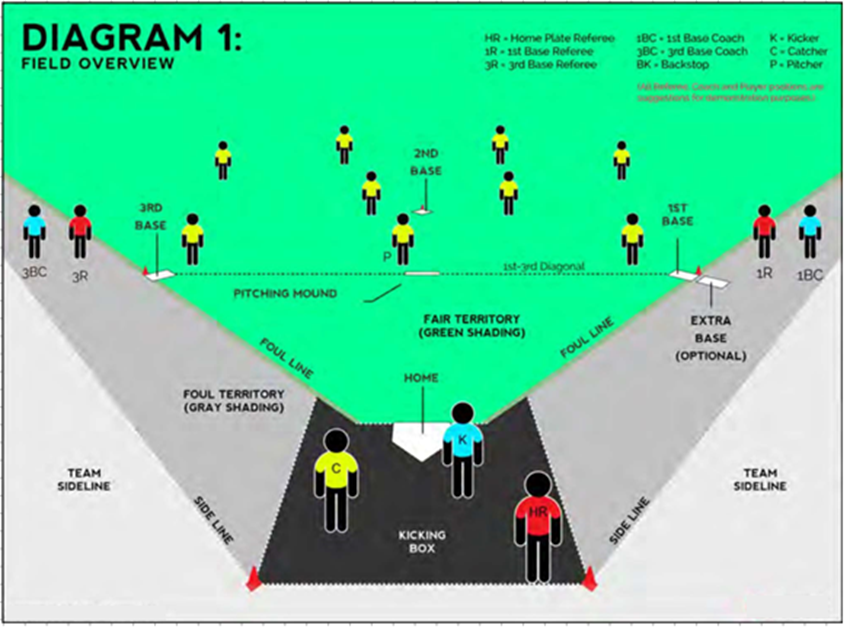
6.1 All fielders besides the catcher must remain in fair territory behind the 1st-3rd base line.
6.2 Proper field position must be maintained by all fielders until the pitched ball reaches the kicker.
a. Failure to be properly positioned with the parameters of section 6.1 shall result in a dead ball and a "Position Warning" to the team that caused the infraction. The pitch shall be declared a ball.
b. Subsequent Position Infractions shall result in the kicker being awarded first base regardless of the outcome of the pitch and kick.
c. The kicking team may decline Position Violation penalties and accept the result of the play.
6.3 There is no infield fly rule, and the defense must actively record an out in an infield fly situation.
a. In accordance with the spirit of the infield fly rule, the defense may only record one out after dropping an infield fly or line drive on a player forced to advanced. Players may continue to advance past the guaranteed base at their own risk. Example: Runners on first and second, one out, Infielder drops fly ball/line drive to try and make a double play and throws the ball to third, or tags the runner running to third. The other runners are now guaranteed first and second base. If either runner tries to advance past the guaranteed base, the defense may get them out.
b. It does not matter if the defense intentionally or unintentionally dropped the fly ball or line drive. If a competent runner cannot try to advance to the next base because they would be doubled up if the ball was caught, the defense may not drop the ball and get a double play.
6.4 The first baseman may not interfere with the runner's path to the safety bag on an inaccurately thrown ball, or the runner shall be declared safe.
a. If the runner has to deviate from their path to the safety bag to avoid physical contact with the first baseman or physically contacts the first baseman, the runner shall be declared safe.
b. The first baseman may throw the ball at the runner or tag them with the ball, as long as the action does not interfere with or force the runner to deviate from their path to the safety bag.
6.5 In a non force-out situation, players possessing the ball may occupy the runner's baseline to tag them out.
6.6 Defenders shall stand on home plate with possession of the ball to get a runner attempting to score out. Rules are similar to force outs at first base; however, there is no commit line and runners not forced to advance may retreat to third base at any time. If a defender possesses the ball in contact with home plate as a runner touches the safety home plate, the runner shall be ruled out.
a. All Base runners will run to the safety Home Plate. If the runner attempts to run to Home Plate, their team shall be given a warning. Runners shall be declared out if contact is made with a defender attempting to make a play while running to the real home plate, or for a second team safety bag violation.
7.0 KICKING
7.01 All kicks must be made by foot or leg, below hip level. Any ball touched by the kicker with foot or leg is a kick.
7.02 All kicks must occur:
a) The kicker's plant foot must be behind home plate while attempting a kick. If the kicker's plant foot is in the air during contact (i.e. a bunt attempt), the step before contact must have been initiated from the behind home plate.
b) The kicker may line up outside of the kicking box.
c) If the kicker's kick is declared illegal or if the ball makes contact with the kicker twice (double kick) during the kicking motion, the referee shall declare a dead ball and the pitch shall count as a strike.
8.0 RUNNING AND SCORING
8.01 Runners must stay within their natural baseline. Any runner excessively outside their baseline (5 yards) is out.
8.02 Runners may choose their path from one base to the next, and may follow a natural running arc.
8.03 Runners are required to change course to avoid interference with a fielder making a play on a kicked ball, or will be declared out. Defensive players may not interfere with the runner's path to attempt to catch a ball thrown by another defensive player.
8.04 When attempting to avoid a ball tag, runners may move no more than 5 yards out of their established path.
8.05 Fielders may be within the baseline when doing so is necessary to make an active play on a kicked ball (to include the path to the safety bag on a foul down the first base line), but must otherwise stay out of the runner's chosen baseline at all times.
8.06 Runners hindered by any fielder within the baseline (defined by the runner's natural path between bases), not making an active play for the ball, shall be safe at the base to which they were running. Runners may choose to advance beyond this base while the ball is still in play. Runners may not modify their route to trigger a baseline violation.
8.07 A runner must maintain contact with the base until the ball is kicked. A runner off base when the ball is kicked is out. Leading off or stealing is not allowed.
8.08 Hitting a runner's neck or head with the ball is not allowed in an upright position. Any runner hit in the neck or head shall be considered safe at the base they were running toward when the ball hits the runner. If the runner intentionally uses the head or neck to block the ball, and is so called by the Referee, the runner is out.
a. Runners forfeit headshot protections when sliding, diving, ducking, or otherwise lowering their head below their natural shoulder level.
8.09 Runners are required to tag up on any ball caught in the air by the defense. The tag up may occur at any time after the defense first contacts the ball. After a tag-up a runner may advance. If the defense believes the runner left early, they may "appeal" the play by possessing the ball on the base in a manner similar to a force out prior to the runner retreating to the appropriate base.
a. A tag up is defined by touching the base the runner began the play on after the ball was first contacted by the defense.
b. A runner does not need to wait for the defense to complete the action of the catch to begin advancing.
8.10 Runners traveling from home plate may overrun the safety bag. All runners overrunning first base are required to use the safety bag, not first base. Players may use first base when rounding first base in an attempt to go to second base. Runners may be tagged out after stepping into fair territory.
8.11 Base Running on Overthrows:
a) An overthrow is a ball thrown, kicked, or deflected into foul territory while making a defensive play toward a player or base. Overthrows are considered live balls, unless the ball is obstructed by an object outside of the field of play, then it is considered a dead ball.
b) A runner may advance one base beyond the base the runner is on or running toward if the ball is called dead. Runners must be beyond the halfway line to attempt to go for an additional base. In other words, runners get one additional base beyond where they would be awarded had the defense successfully gotten the ball to the pitcher's circle on any other dead ball.
8.12 Running past another runner is not allowed. The passing runner is out.
8.13 A run scores when a runner touches the safety home plate before the third out is made. All runners "forced" to advance on the kick must safely reach the next bag for any runs to count.
a) A runner who fails to tag up does not constitute a runner forced to advance. If a runner crosses the plate before the defense gets the third out on a runner attempting to tag up, the run counts. Defenses may prevent a run via the "Fourth Out" rule if the defense appeals the scoring runner did not properly tag up after the third out was made on another runner.
8.14 When a base is displaced during play, any runner is safe while in contact with the base's original and correct location, or the base itself. All displaced bases should be restored at the end of each play.
9.0 STRIKES, FOUL BALLS, FAIR BALLS, and BALLS
STRIKES
9.01 A strike is:
a) A legal pitch that the kicker makes no attempt to kick in which the ball passes through the strike zone. A strike is determined by the majority of the ball crossing through the front of the strike zone. The entire ball must remain below the kicker's knee throughout the strike zone to be called a strike.
b) An attempted kick missed by the kicker inside or outside of the strike zone.
c) A foul ball that is not caught by the defense.
d) A kicker strikes out after accruing four (4) strikes.
FOUL BALLS
9.02 A foul ball is:
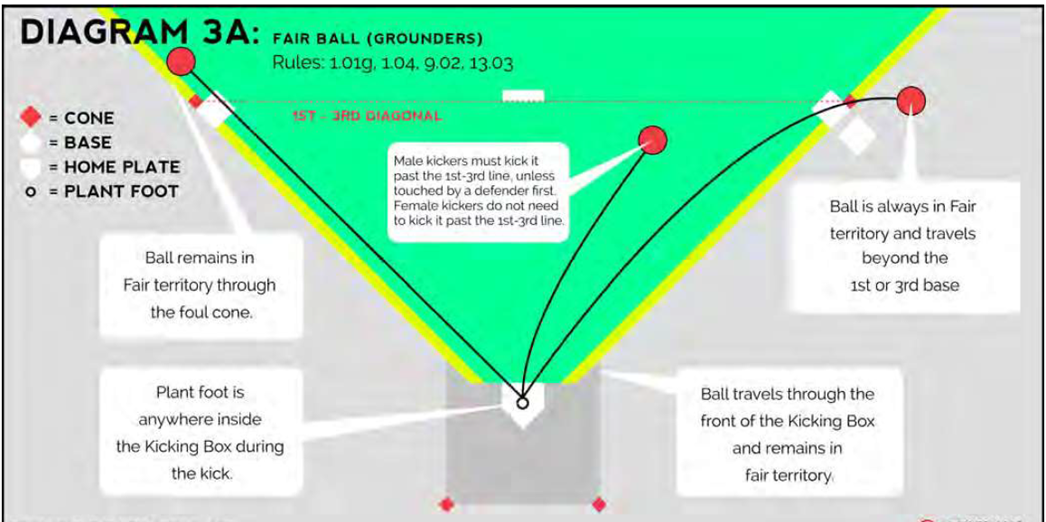
a) A kicked ball first touching a fielder or referee in foul territory, or coming to a stop in foul territory. Fair or foul is determined by the location of the middle of the ball when touched, not the positioning of the fielder. A ball is fair if the middle of the ball is over any part of the foul line.
b) A kicked ball landing in fair territory, but crosses 1st to 3rd line in foul territory.
c) A kicked ball that lands in foul territory beyond the 1st to 3rd line.
d) A ball put into play with any part of the kicker's body at or above the kicker's hip level.
e) A kicked ball touched more than once by the kicker.
f) A kicked ball by a male player that comes to a full stop prior to crossing the 1st-3rd diagonal line without first being touched by a defensive player.
ff) A kicked ball by a male player that is in full contact with the ground may be stopped on the ground by the defense to force a foul.
g) A foul tip is defined as a kick which does not go above the kicker's head and continues backwards through the kicking box, where it is only catchable by the catcher.
h) There is no differentiation between caught foul balls and caught fair balls; the batter is out and all runners must tag up. Caught foul tips result in strikes, not outs, in a manner consistent with baseball rules.
BALLS
9.03 A ball is:
a) A pitch outside of the strike zone as judged by the Referee where a kick or bunt attempt is not attempted.
b) A pitched ball that does not touch the ground at least twice or roll before reaching the kicking box.
c) Any part of a pitched ball extending above the kicker's knee at any point through the strike zone.
d) An illegal pitch.
9.04 A count of four (4) balls advances the kicker to first base.
FAIR BALLS
9.05 A fair ball is:
a) A kicked ball landing and remaining in fair territory.
b) A kicked ball landing in fair territory then traveling into foul territory at or beyond 1st or 3rd base.
c) A kicked ball first touching a player or referee while the ball is in fair territory.
d) A kicked ball that touches a runner in fair territory.
e) A kicked ball that touches the kicker once outside the kicking box before touching the ground in foul territory.
f) A kicked ball by a male player that is touched by a defensive player prior to coming to a full stop and being declared a foul ball.
10.0 OUTS
10.01 A count of three (3) outs by a team completes the team's half of the inning.
10.02 An out is:
a) A total count of 4 strikes and/or fouls.
b) Any kicked ball (fair or foul) that is caught by a fielder. Any part of the ball may incidentally touch the ground during the act of catching and still be ruled an out if the fielder first displays full control of the ball and maintains control after touching the ground.
c) A Force Out, being the tag by any part of a fielder's body of a base to which a runner is forced to run, before the runner arrives at the base, while the fielder has control of the ball. The ball may be touching the ground if the fielder displays full control of the ball while simultaneously tagging the base.
d) A runner touched by the ball or who touches the ball at any time while not on base they can legally occupy at the end of the play while the ball is live.
e) A kicker or runner that interferes with the ball
f) A force out before the runner originating at that base can tag-up as required due to a caught ball.
g) A runner off base when the ball is kicked.
h) A runner physically assisted by a team member during play.
i) A runner that passes another runner.
j) A runner 5 yards outside of the baseline. Runners may choose their own path between bases, as long as they remain within five yards of the imaginary line connecting the bases they are traveling between. Fielders may not position themselves in a way to interfere with the runner's chosen path unless actively making a play on a kicked ball. It is the runner's responsibility to avoid fielders making a play on a kicked ball. Fielders may not interfere with a runner's path to catch a ball thrown from another fielder.
k) A runner who misses a base, as called upon the conclusion of the play.
l) A runner who fails to properly tag up on a caught ball, as called upon the conclusion of the play.
m) A runner touched by the ball while on a base they are forced to vacate by the kicker becoming a runner.
n) A runner coming from home plate who steps on First Base when required to use the Safety Base. Any plays at first base require use of the Safety Bag.
o) Each team may be granted one (1) warning.
p) A player improperly occupying the sideline area after their team has been issued a warning.
11.0 BALL IN PLAY
11.01 Once a player has the ball in control and retains possession in the pitching circle, the play ends. Runners past the halfway mark between bases shall be awarded the next base, while runners shy of the halfway mark shall return to their previous base.
11.02 Interference is:
a) When any object outside the field of play, touches or is touched by a ball in play in fair territory. This interference b) Causes the play to end, and runners shall proceed to the base to which they were headed.
b) When any runner intentionally touches a ball, or hinders a fielder. This interference causes the play to end, and both the kicker and offending runner to be out. Any other runners shall return to the base from which they came.
11.03 During any play where a ball is popped or deflates significantly, that play shall be replayed with a properly inflated ball.
12.0 INJURY AND SUBSTITUTIONS
12.01 In cases of injury or illness, a time-out may be requested for participant removal and replacement with a teammate as a substitute. If the participant later returns to play, the participant must be inserted in the same written kicking order position previously held.
12.02 If a player is ejected, injured, becomes ill and cannot continue, or leaves the game for any reason, the written kicking order will continue in the same formation, less the removed player. A player removed from the kicking order for ejection, injury, illness, or any reason does not constitute an improper kicking order and there is no "automatic out" when the removed player's spot in the order is reached.
12.03 Any player removed from the game for injury or illness must be noted on both team written kicking orders and mentioned to the Head Referee.
12.04 Substitutions for injured players may be made with players outside the game, if the team is brought below eleven (11) field players (4 girls) with consent of the head ref and input from the opposing team captains.
12.05 Any substitution players brought in prior to or during the game may not play pitcher or catcher.
a) Substitution players from outside the league may play during the regular season after signing a liability waiver.
b) Substitution players from outside the league may only play during the first game. After the first round, substitutes must come from eliminated teams. The opposing captain and referee must approve all substitutions (no "all stars").
12.06 The pitcher and catcher may only be substituted at the beginning of each inning.
12.07 Injured runners may be substituted after the completion of a play with referee's discretion.
a) Substituted runners will be replaced with the last person in the lineup of their gender in the dugout.
b) If a Substitute Runner is on base when their official lineup position is up to kick, they will be declared out.
13.0 REFEREES
13.01 Games must be officiated by at least two (2) officials, the Head Referee will be one of the team captains. When available, three (3) officials referee each game: a Head Referee, a First Base Referee, and Third Base Referee. The Head Referee governs allgame play and issues all final rulings regarding any and all game play. Other Referees may assist these officials when available.
13.02 Prior to each game, the Head Referee must conduct a meeting with the Captains of each team, to address any ground rules in effect, to ensure the exchange of team lineups, and to identify the designated Captains who will be authorized to discuss calls with the Referees during the game.
13.03 Referees have jurisdiction over all play and may:
a) Call a timeout
b) Call off a game due to darkness, rain or other cause at the Referee's discretion.
c) Penalize a player, including game ejection, for any reason. This includes but is not limited to unsportsmanlike conduct, fighting, delay of game and excessive verbal abuse. Ejected participants must leave the field area and may not return to the game.
13.04 Referees must:
a) Cancel the game if lightning is seen, or delay it until safe to continue.
b) Keep a record of the final game score.
13.05 Referees may make rulings on any points not specifically covered in the rules (at the time of occurrence), but the ruling shall not be deemed as a precedent for future rulings outside of that game.
14.0 THE PLAYING FIELD
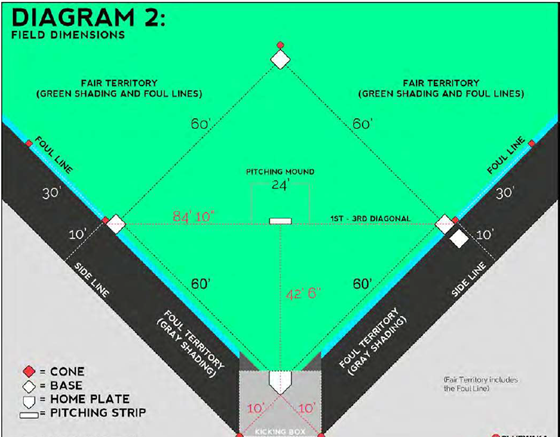
14.01 The field shall be established on any safe terrain suitable for play in accordance with the following provisions which equal the dimensions of a softball field (see Diagram 2):
14.02 The kickball diamond is a square with equal sides of 60 feet or about 20 paces with a base at each corner.
14.03 The distance from the front of home plate to the back of second base and from outside of first base to the outside of third base is 84 feet 10 1/4 inches or about 28 paces.
14.04 The pitching strip is in the center of the diamond, 48 feet 5 1/8 inches or about 15 paces from home plate, and 6 feet behind the 1st-3rd base diagonal.
14.05 The pitching mound extends 12 feet from the center of the field.
14.06 The sidelines are lines 10 feet on the outside of and parallel to the foul lines, the area between the foul lines and the sidelines is the sideline area.
14.07 The kicking box is a twelve foot wide by 6 foot deep rectangle with the front of the box aligned with the front of home plate. The kicker is not required to start in the kicking box, however the kick must occur within the kicking box.
14.08 The foul lines are fair territory.
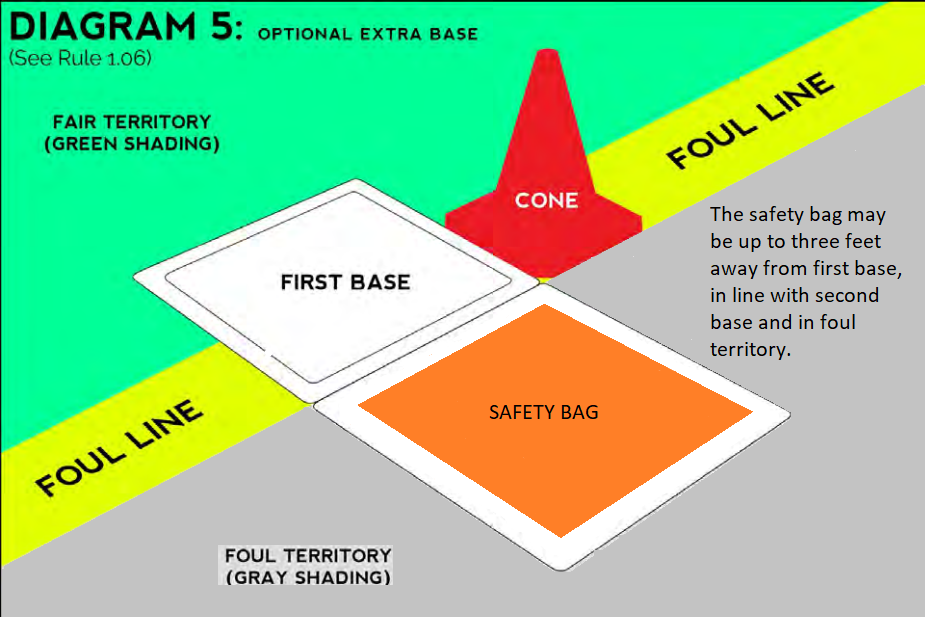
14.09 The Safety Bases: To facilitate player safety and prevent collisions, additional safety bases are utilized at First Base and Home Plate.
a) The First Base safety base is placed three (3) feet adjacent to the fair base in foul territory. The Home safety base is placed in foul territory, approximately six (6) feet from the real home plate, aligned with the third-base foul line.
14.10 Rules for the Safety Bases:
a) The safety bases are exclusively for runners traveling to First Base (from home) or to Home Plate (from third base).
b) Fielders are strictly prohibited from touching or using the safety bases at First Base or Home Plate. To record an out, the fielder must be in contact with the "real" base (fair territory) or legally tag the runner. An out recorded while a fielder is touching a safety base shall be ruled invalid, and the runner shall be declared safe.
c) Runners must touch the safety base when a play is being made. Touching the "real" base instead of the safety base results in a team warning. A second team safety base violation results in an automatic out. Any contact with a defender making a play on the real base results in an immediate out.
d) Once a runner has reached First Base safely, the runner must start the next play on the "real" First Base. Any runner standing on or touching the Safety Base at the beginning of the next play will be out.
e) Out Protocol at Home: For a force out, the defender must have possession of the ball while in contact with the "real" home plate before the runner touches the safety base. For a non-force play, the defender must legally tag the runner before the runner touches the safety base.
f) A runner not forced to advance may retreat to third base at any time to avoid a tag. During a rundown (pickle), the defender must apply a tag to the runner.
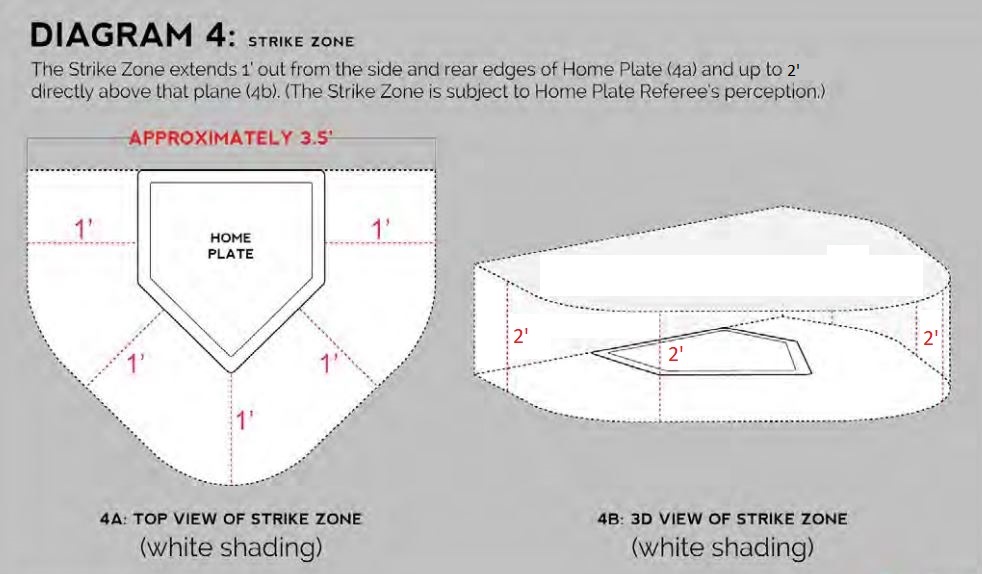
14.11 The strike zone is a three-dimensional irregular pentagon based on the shape of home plate and is approximately two (2) foot in height. The front of the zone aligns with the front of home plate. The sides of the zone extend one (1) foot to either side of the plate. The strike zone will be marked by painted lines.
14.12 Any part of a player or Referee in fair territory is an extension of fair territory. A player jumping from fair territory is in fair territory while in the air. A player in foul territory does not extend foul territory by jumping or reaching into fair territory.
14.13 Upon notification to the Head Referee of any improper field set up, the field layout shall be corrected before the beginning of the next play. Protest based on field set up will not be considered.
14.14 Sideline area. Prior to the kick, no participants (or spectators) may be in the sideline area (Diagram 2) except for the kicker, Referees and designated base coaches. After the kick, fielders and base runners in the process of playing the game may also occupy the sideline area. The first infraction of this rule will result in a warning to the team that caused the infraction. The second and each subsequent infraction will result in an out for the next kicker in the written kicking order on the team that caused the infraction.
15.0 EQUIPMENT
15.01 While participating, players must properly wear the official athletic clothing designated for their use.
15.02 Athletic shoes are encouraged. Metal cleats are not allowed. Players wearing metal cleats will be forced to remove them prior to them continuing play.
15.03 Players may wear protective equipment providing it does not offer the wearer an unfair performance advantage. Any equipment deemed by the Head Referee as a performance enhancement must be removed or the player will be removed from play.
15.04 The official kickball is the red WAKA Logo Kickball, measuring 10 inches in diameter when properly inflated to a pressure of 1.5 pounds per square inch.
15.05 All player attire is an extension of the player.
16.0 OTHER
The spirit of these rules is to ensure a fun environment and participant enjoyment. All games are to be played in a sportsmanlike manner. If necessary, R.A.D. Sports Staff will address any inconsistencies, discrepancies, and misunderstandings in accordance with the spirit of these rules. These rules are maintained at www.recessafterdark.com and are subject to change.
17.0 Diagrams